
Patient Info
All ultrasounds are by appointment, and require a referral from your doctor. Please contact our office to book an appointment time.
7 Convenient Locations
Bulk Billed
Results Within 24 Hours
Urgent Same-Day Appointments
What to Bring to Your Appointment
On the day, you will need to bring your
1. Request Form
2. Medicare or Department of Veterans Affairs card
3. Any relevant previous Imaging or Reports

Fasting Before Your Appointment
Some examinations require you to fast in preparation for the test. See fasting requirements for your specific examination
Mesenteric arteries -8 hour fast
Aorto-iliac and femoropopliteal arteries – 6 hour fast
Renal arteries – 6 hour fast
Aorta and iliac arteries -6 hour fast
Carotid vertebral arteries – Nil
Varicose veins (chronic venous disease) – Nil
Venous thrombosis – Nil
Leg arteries (femoropopliteal) – Nil
Upper limb arteries – Nil
Upper limb veins – Nil
Vein mapping/marking before surgery – Nil
Thoracic Outlet – Nil
AV Fistula – Nil
Ankle Brachial Index, rest and exercise study – Nil

What You Can Expect During Your Appointment
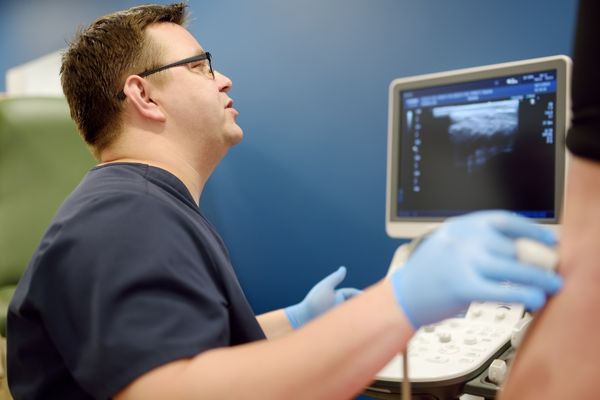
You may need to stand, sit or lay down depending on the procedure. The sonographer performing the test places a clear, water-based ultrasound gel on your skin and moves a hand-held probe over the area. The gel enables the probe to transmit sound waves. These waves bounce off the body structures, to create an image on the ultrasound machine.
The images and data generated throughout the test allow the sonographers (ultrasound operator) and vascular surgeons to review and diagnose any irregularities in your veins and arteries, such as blockages, aneurysms and other signs of disease or malfunction. This data is then stored for future reference. The technique is non-invasive meaning there is no need for needles or surgical incisions and is considered to be very low risk.
Urgent results will be communicated directly with your doctor as soon as possible.
Procedure Specific Information
Click the procedure to access specific information regarding your procedure.
Carotid Ultrasound
The Carotid Arteries on both sides of your neck supply blood to brain. Blockages or narrowing of this artery may increase your risk of stroke. Ultrasound assesses the structure of the artery and the blood flow within the artery. There is no preparation required for this test and the test will take less than 30 minutes to perform.
Aortoiliac Ultrasound
Aortoiliac ultrasound is performed to assess for aneurysmal disease (swelling of the artery) or significant fatty plaque build ups that may cause narrowing of the artery. The test will take less than 30 minutes and it is important to FAST from food and fluid 4 hours prior. Small sips of water can be taken for medication.
Lower Limb Arterial Ultrasound
Lower limb arterial ultrasound is performed to assess for aneurysmal disease (swelling of the artery) or significant fatty plaque buildups that may cause narrowing of the artery. The narrowing (stenosis) may lead to a symptom called claudication, which is defined as pain or cramping in the lower leg while walking. The test may take up to one hour.
Renal Artery Ultrasound
Assessment of the arteries supplying blood to the kidneys. Narrowing of these arteries may cause high blood pressure or decrease the size and function of the affected kidney. This test may take up to 30 minutes and it is imperative to FAST from fluid, food and smoking for 6 hours prior to the examination.
Upper Limb Extremity Arterial Ultrasound
This test is performed to assess for significant fatty plaque build ups that may cause narrowing of the artery or for thoracic outlet syndrome whereupon certain arm movements may cause closure of the artery. This examination may take 30 minutes and no preparation is required.
Venous Insufficiency studies (Varicose Veins)
Venous insufficiency study is an assessment of the deep and superficial veins of the leg. Blood should return from the lower limb back to the heart via veins. When valves in the veins become incompetent blood refluxes back towards the lower limb. This increases the blood pressure in veins causing dilatation and skin changes. This assessment may be performed in the standing position to maximise the effect of gravity. The examination of both legs may take up to one hour. No preparation is required.
Deep Vein Thrombosis Ultrasound
Deep Vein thrombosis ultrasound looks for blockages in the veins caused by blood clots. The vein is assessed for normal flow patterns and compressed to ensure its patency. The examination of both legs may take up to 45 minutes, no preparation is required.
Ovarian and Pelvic Vein Ultrasound
Varicose veins can occur not only in the legs but also in the pelvis. Dilated veins around the pelvis can lead to pelvic congestion syndrome or lower limb varicose veins. Assessment is performed externally with the patient lying down and may take up to 30 minutes.
Upper Limb Venous Studies
Veins of the arms can be assessed for blood clots, which may cause swelling or pain in the arm and/or hand. The scan is performed from neck through shoulder to forearm and may take up to 30 minutes.
Schedule Your Ultrasound Appointment
To book your appointment, please contact our main office on (03) 9770 0773 or info@vascularinvestigations.com.au Alternatively you can fill out the contact form below and our friendly staff will assist you in scheduling a convenient appointment and provide any additional information you may need.

We deliver accurate, fast-turnaround diagnostic ultrasound, for optimal vascular health management.
